Note to blog subscribers: Click on the Heading to view posts on the website with interactive course content, quizzes and updated materials.
Live Lecture
Warm Up Questions
Definitions
Perfect Square is a natural number that can be written as the product of two equal factors.,
For example: 4, 25, 81, 441, …
Observations
- Last Digit of the Multiple is influenced only by the Last Digits of the Numbers.
- No perfect square ends with 2, 3, 7, 8.
- No perfect square ends with an odd number of zeros.
- Upon prime factorization, all their prime factors have even multiplicities.
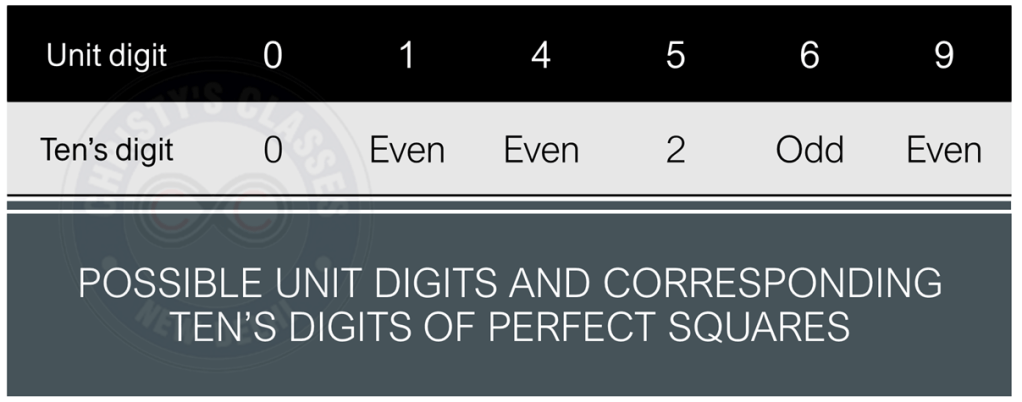
A = 45xyz26, B = 2xyz175, C = xyz3310
Question
Abhirup had a question on “Upon prime factorization, all their prime factors have even multiplicities.” How does that work?
Here’s how. For example, consider 36. 36 = 62 .
Prime factorisation of 36 is given by 36 = 22 x 32.
Another example will be 484 = 222 = 112 x 22.
Why is it so? We can give prime factorisation of any natural number, say n = am x bn x cp x …, where a, b, c, … are prime numbers.
When you square it, n2 = (am)2 x (bn)2 x (cp)2 x … = a2m x b2n x c2p x …
Thus, all the prime numbers have even multiplicities.
More Materials
Follow us on one of these modes for more quizzes and updates. Feel free to ask your doubts in the comments below or in the video comments!
More materials and video descriptions will be given in this blog. Please don’t forget to follow this blog!
You can print this page for PDF.
 Christy's Classes