HOW TO ATTEND THE COMPLETE COURSE : Visit ” Christy’s Classes ” YouTube Channel , ( https://youtube.com/@ChristysClasses?si=LUt0PVGQQVewNT3T ) SUBSCRIBE And PRESS BELL ICON You’ll get notified every time the lecture goes live.
TIMING : 8:30 PM – 9:00 PM
EDUCATOR : Jesse Francis
SPREAD THE WORD WITH ALL YOUR FRIENDS AND FELLOW ASPIRANTS AND INVITE THEM TO GET FULL TRAINING FOR CSIR-UGC NET PART A !!
Note to blog subscribers: Click on the Heading to view posts on the website with interactive course content, quizzes and updated materials.
Live Lecture
Exponent Form
When a number is multiplied by itself several times, it can be written in a short form with the help of exponents. Example: 5×5×5×5=54. Here, 54 is called an exponential expression.
The number multiplied by itself, again and again, is the base. The number of times the number appears or is multiplied is the exponent. In 54, 5 is the base and 4 is the exponent.
Surds
The values in the square root or cube root or any other roots, which cannot be further simplified into whole numbers or integers, are known as a surd. Example: The value of √5.
Laws of Exponent
am × an = am+n
am / an= am-n
am × bm = (ab)m
am/ bm = (a/b)m
(am)n = amn
a(1/m) = m√a
a-m = 1/am
am/n = n√am
a0 = 1
Which of the following values is same as ? (CSIR-NET FEB 2022, JUNE 2017)
That’s wrong! Hint:
That’s wrong! Hint:
That’s right!
That’s wrong! Hint:
equals (CSIR-NET December 2012)
That’s wrong! Hint: Use the laws of exponents!
That’s right!
That’s wrong! Hint: Use the laws of exponents!
Some Important Expansions
(a + b)2 = a2 + 2ab + b2
(a – b)2 = a2 – 2ab + b2
a2 – b2 = (a + b)(a – b)
(a + b)3 = a3 + 3a2b + 3ab2 + b3
(a – b)3 = a3 – 3a2b + 3ab2 – b3
Suppose . The value of x is (CSIR-NET JUNE 2023)
-21
That’s wrong! Hint: 729 = 9 x 9 x 9, 81 = 9 x 9!
-21.5
That’s right!
-22
That’s wrong! Hint: 729 = 9 x 9 x 9, 81 = 9 x 9!
-20.5
That’s wrong! Hint: 729 = 9 x 9 x 9, 81 = 9 x 9!
Which of the following is the largest? (CSIR-NET JUNE 2019)
That’s wrong! Hint: Try making the exponent same!
That’s right!
That’s wrong! Hint: Try making the exponent same!
Which of the following is the largest? (CSIR-NET JUNE 2017)
That’s wrong! Hint: Try making the base same!
That’s right!
That’s wrong! Hint: Try making the exponent same!
Which of the following numbers is the largest? (CSIR-NET DEC 2012)
That’s right!
That’s wrong! Hint: Try making the base same!
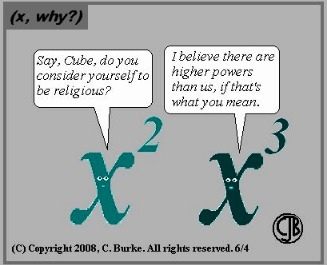
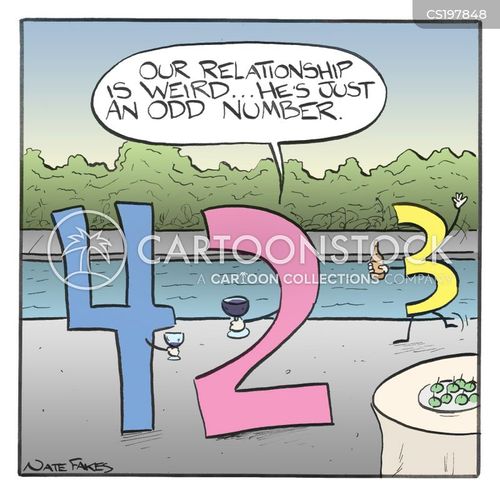
Here’s a comic to wind up the discussion:
More Materials
Follow us on one of these modes for more quizzes and updates. Feel free to ask your doubts in the comments below or in the video comments!
Note to blog subscribers: Click on the Heading to view posts on the website with interactive course content, quizzes and updated materials.
Live Lecture
Number Systems
Place value
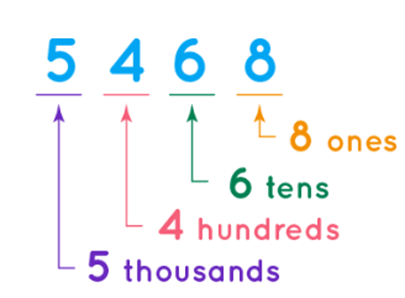
Place value is the value of each digit in a number. The value of every digit in a number is different based on its position. A number might have two similar digits but different values, which is decided by the position that the digit holds in the number.
Place Value and Face Value
Given the number is 5369.
Face value of 9 is 9 and Place value of 9 is 9
Face value of 6 is 6 and place value of 6 is 60 (Sixty)
Face value of 3 is 3 and place value of 3 is 300 (Three hundred)
Face value of 5 is 5 and place value of 5 is 5000 (Five thousand)
Therefore, we can see, the face value of the digits in number 5369 represents the actual value of the digit.
Representing numbers in Decimal Number System
2-digit number – 10x+y
3-digit number – 100x+10y+z
…
In general, a n-digit number
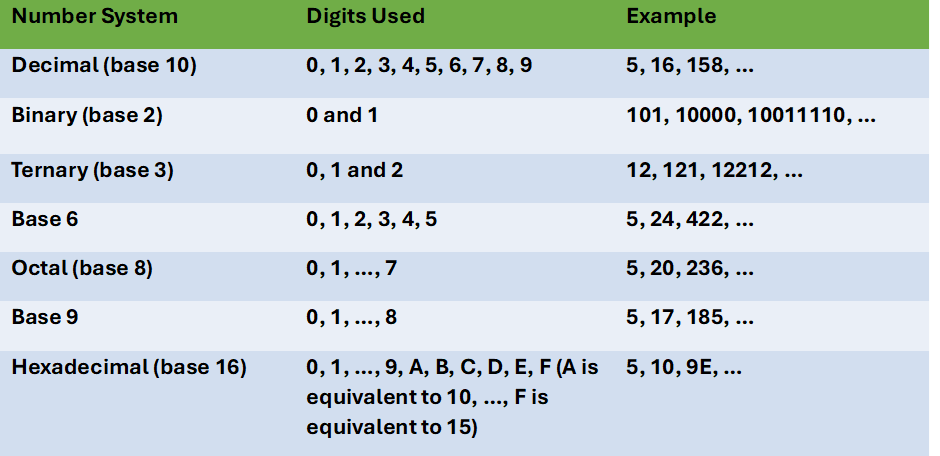
Representing numbers in any Number System
Watch the video to learn more.
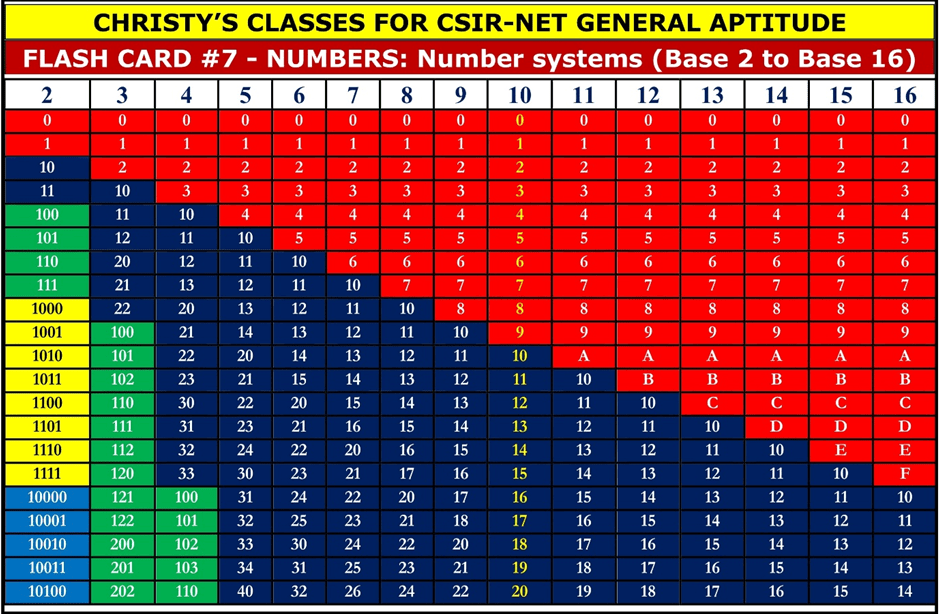
Here’s the flashcard:
Conversion of Number Systems
Refer to the lecture for details.
0-40 in Different Number Systems (Flash Card)
Buy/refer to the flashcard series for more content like this. Click here for full catalogue.
Convert to other number systems.
Hexadecimal: Show Answer
37
Decimal: Show Answer
55
Binary: Show Answer
67
Convert to other number systems.
Hexadecimal: Show Answer
A
Octal: Show Answer
12
Binary: Show Answer
1010
If 25 is written as
Then how will 101 be written? (CSIR-NET SEPT 2022 – CS)
1010101
That’s wrong! Is it a familiar number system?
1100111
That’s wrong! Is it a familiar number system?
1101101
That’s wrong! Is it a familiar number system?
1100101
Here, 25 is converted to binary form.
Consider a number 54 expressed in a base different from 10. What is the base of this number system if its equivalent value in the decimal system is 49? (CSIR-NET JUNE 2018)
1
That’s wrong! If x is the base, then … Then x is?
3
That’s wrong! If x is the base, then … Then x is?
6
That’s wrong! If x is the base, then … Then x is?
9
That’s right!
N is a two-digit number such that the product of its digits when added to their sum = N. The unit digit of N would be: (CSIR-NET JUNE 2017)
1
That’s wrong! Hint: Write N = 10x + y. Then Product of digits = xy and the Sum of digits = x + y.
7
That’s wrong! Hint: Write N = 10x + y. Then Product of digits = xy and the Sum of digits = x + y.
8
That’s wrong! Hint: Write N = 10x + y. Then Product of digits = xy and the Sum of digits = x + y.
9
That’s right!
Choose the four-digit number, in which the product of the first & fourth digits is 40 and the product of the middle digits is 28. The thousands digit is as much less than the unit digit as the hundreds digit is less than tens digit. (CSIR-NET JUNE 2016)
5478
That’s right!
5748
That’s wrong! Hint: The thousands digit is < Unit digit and hundreds digit is less than tens!
8745
That's wrong! Hint: The thousands digit is < Unit digit and hundreds digit is less than tens!
8475
That's wrong! Hint: The thousands digit is < Unit digit and hundreds digit is less than tens!
If D = ABC + BCA + CAB where A, B, C are decimal digits, then D is divisible by? (CSIR-NET DEC 2018)
37 and 29
That's wrong! Hint: Try taking the simplest example!
37 but not 29
That's right!
29 but not 37
That's wrong! Hint: Try taking the simplest example!
Neither 29 nor 37
That's wrong! Hint: Try taking the simplest example!
More Materials
Follow us on one of these modes for more quizzes and updates. Feel free to ask your doubts in the comments below or in the video comments!
Note to blog subscribers: Click on the Heading to view posts on the website with interactive course content, quizzes and updated materials.
Live Lecture
Tests for Divisibility
Divisibility by 2: Check if the last digit is even. i.e., 0, 2, 4, 6 or 8.
Divisibility by 3: Check if the sum of its digits is divisible by 3.
Divisibility by 4: Check if the number formed by the last 2 digits is divisible by 4.
Divisibility by 5: Check if its last digit is 0 or 5.
Divisibility by 6: Check if the number is divisible by both 2 and 3.
Divisibility by 7: To check whether a given number is divisible by 7, subtract twice the unit digit from the number represented by the remaining digits of the number to obtain an integer. The original number is divisible by 7 if the obtained integer is divisible by 7.
Divisibility by 8: Check if the number formed by the last 3 digits is divisible by 8.
Divisibility by 9: Check if the sum of the digits is divisible by 9.
Divisibility by 11: Mystery! It’s hidden somewhere in this page! Try to find it!
Division Algorithm
Dividend = Divisor × Quotient + Remainder
For example: 62 = 10 × 6 + 2 and 60 = 10 × 6 + 0
Factors and Factorisation
Prime factorisation is a process of factoring a number in terms of prime numbers i.e. The factors will be prime numbers.
The simplest algorithm to find the prime factors of a number is to keep on dividing the original number by prime factors until we get the remainder equal to 1.
Factors: A number is a factor of another, if the former exactly divides the latter without leaving a remainder (remainder is zero). For example: 5 is a factor of 30.
Multiples: A multiple is a number which is exactly divisible by another. For example: 30 is a multiple of 5.
Greatest Common Divisor (HCF)
The GCD or HCF of two or more than two numbers is the greatest number that divides each of them exactly.
Least Common Multiple (LCM)
The LCM of two or more numbers is the smallest number which is exactly divisible by each one of the given numbers.
Refer to the lecture for methods to find GDC/LCM and important properties of it!
GCD of 12, 24, 15 is
1
That’s wrong, try again!
12
That’s wrong, try again!
3
That’s right!
5
That’s wrong, try again!
In a ten-digit mobile number 999ABCDEEE, A, B, C and D are distinct prime numbers. The mobile number is never divisible by (CSIR-NET NOV 2020)
3
That’s wrong, try again!
4
That’s wrong, try again!
5
That’s right!
8
That’s wrong, try again!
Which is the odd one out based on a divisibility test?
154, 286, 363, 474, 572, 682 (CSIR-NET JUNE 2017)
474
That’s right!
572
That’s wrong! Hint: Divisibility test for 11: A number is divisible by 11 if the difference of the sum of the digits in the even and odd positions in the number is divisible by 11.
682
That’s wrong! Hint: Divisibility test for 11: A number is divisible by 11 if the difference of the sum of the digits in the even and odd positions in the number is divisible by 11.
154
That’s wrong! Hint: Divisibility test for 11: A number is divisible by 11 if the difference of the sum of the digits in the even and odd positions in the number is divisible by 11.
How many integers in the set {1,2, 3, …, 100} have an odd number of divisors? (CSIR-NET Feb 2022)
10
That’s right!
27
That’s wrong! Hint: An integer has exactly 3 divisors if the integer is the square of a prime number as the three factors are 1, the integer itself and its square root.
36
That’s wrong! Hint: An integer has exactly 3 divisors if the integer is the square of a prime number as the three factors are 1, the integer itself and its square root.
12
That’s wrong! Hint: An integer has exactly 3 divisors if the integer is the square of a prime number as the three factors are 1, the integer itself and its square root.
More Materials
Watch this video from previous lecture for more Previous Year Question and discussion:
Would you like a session on mysterious infinity, division by zero and such interesting ideas in mathematics? Hit a thumbs up below and like this post below to let us know!
Follow us on one of these modes for more quizzes and updates. Feel free to ask your doubts in the comments below or in the video comments!
More materials and video descriptions will be given in this blog. Please don’t forget to follow this blog!
Someone had enquired about mathematics sessions. For mathematics related content, please check out our sister project, Mathematicos.in and the YouTube Channel.
Note to blog subscribers: Click on the Heading to view posts on the website with interactive course content, quizzes and updated materials.
Live Lecture
Session Outline
A lot of familiar (or less familiar) words about numbers.
Exploring their precise meaning.
Building up for problems to come in upcoming sessions.
Why?
Questions may contain these words.
Some minor questions we never asked
Is 0 a Natural number?
Is 19.333333… a rational number?
Is π=22/7?
Interesting Sets of Numbers We Talked About
“Precise” Meanings
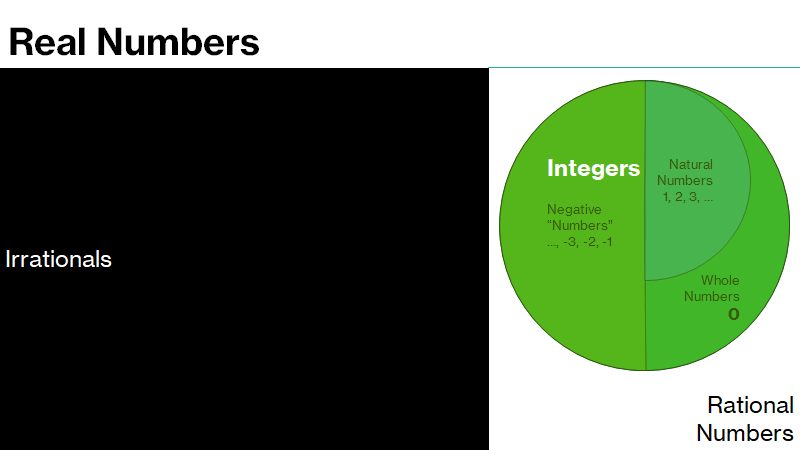
Natural Numbers: The counting numbers like 1, 2, 3, 4… are called natural numbers.
Whole numbers: Natural numbers along with zero are called whole numbers.
Integers: All counting numbers including zero and the negatives of the counting numbers form the set of integers. Hence …, –3, –2, –1, 0, 1, 2, 3… are all integers.
A few terms to remember: “Positive Integers”, “Negative Integers”, “Non-negative integers” and “Non-positive integers”.
Classification of Integers: Even (divisible by 2), Odd (not divisible by 2).
Rational Numbers (Fractions): A rational number represents a part of a whole or, more generally, any number of equal parts.
Mixed Fraction: An improper fraction can be expressed as a whole number and a proper fraction. This expression is called a mixed fraction.
Decimal representation of rational numbers: When a rational number is written in decimal points, the digits after the decimal will
Either stop after a while (Eg. 1.343443)
Or repeat the same pattern forever (Eg. 1.546754675467…. “5467” repeats forever).
Irrationals: Numbers with infinite decimal expansion without any pattern are called irrationals. π is an irrational number.
Real numbers: Rational numbers, along with irrational numbers are called real numbers.
Quiz
Which is the smallest natural number given in the options?”
0
Remember? Natural numbers are counting numbers… But zero is not a natural number!
1
That’s right
-1
Natural numbers are Positive Integers!
2
Try again!
True or False: We have a rational number which is an irrational number.
TRUE
An irrational number is a number which is not rational. Hence there cannot a rational number which is also irrational!
FALSE
That’s right
True or False: Pi = 22/7
TRUE
Try again!
FALSE
Pi is an irrational number while 22/7 is rational. In fact, 22/7 is a rational approximation of pi.
Additionally, we used terms like, “Sets”, “Venn Diagram”, “[set] contained in [another set]” etc.
Observations from Chair-Arranging Experiment
Odd number of chairs cannot be arranged in two rows to make a perfect rectangle.
Even number of chairs can be arranged in two rows to make a perfect rectangle.
Addition
Even + Even = Even
Odd + Odd = Even
Even + Odd = Odd
Odd + Even = Odd
Multiplication
Even × Even = Even
Even × Odd = Even
Odd × Even = Even
Odd × Odd = Odd
Classification of Natural Numbers
Prime Numbers: A natural number which has exactly two positive factors (divisors), namely itself and 1. For example, 2, 3, 5, 7, 11, …
Composite Numbers: A natural number which has more than two positive factors. For example: 4, 6, 8, 9, 10,…
Note: 1 is neither prime nor composite as it has only one factor. Note the correction from how it was mentioned in the video lecture.
Quizzes
Ture/False: Is 0 a prime number?
TRUE
0 is not a natural number, hence not prime!
FALSE
True. 0 is not a natural number to begin with!
Why is 1 not a prime?
See answer
1 is a natural number but it has only one positive divisor, 1. Hence it cannot be prime.
How many prime numbers are there less than 10?
2
That’s wrong!
4
That’s right. 2,3,5,7
5
That’s wrong!
7
That’s wrong!
How many even prime numbers are there less than 1000?
0
That’s wrong! Try again!
1
True! Any even positive integer will be divisible by itself, 1 and 2 (by the definition of even numbers).
2
That’s wrong! Try again!
4
That’s wrong! Try again!
/
Why is composite numbers not called “natural numbers with more than two divisors”?
Show explanation
Then 1 (which has only one positive integer divisor) will not be a composite or prime number.
Note to blog subscribers: Click on the Heading to view post on the website with interactive course content, quizzes and updated materials.
Live Class
Tips
Tip 1: Have an Objective Approach
When you see a question, do the following:
Read the question and the options given
Choose the less time-consuming method
Solve the question
Six persons P,Q,R,S,T and U sit around a circular table with equal distance between neighbours. P is to the immediate left of R. T and S do not sit next to each other, and T and R are diametrically opposite to each other. Which of the following is NOT possible? (CSIR NET FEB 2022)
Q and P are sitting diametrically opposite to each other
Q and P are sitting diametrically opposite to each other: This is possible. We can place Q and P in two opposite seats.
P and U are sitting diametrically opposite to each other
P and U are sitting diametrically opposite to each other: This is possible. We can place P and U in two opposite seats.
S and T are sitting diametrically opposite to each other
S and T are sitting diametrically opposite to each other: This is not possible because T and R are already diametrically opposite to each other.
S and Q are sitting diametrically opposite to each other
S and Q are sitting diametrically opposite to each other: This is possible. We can place S and Q in two opposite seats.
Tip 2: Time factor
2 minutes – Maximum Time for any question
30 minutes – Maximum Time for Part A Section
Assign Time for Part A, Part B and Part C
Tip 3: Choose the Right Method
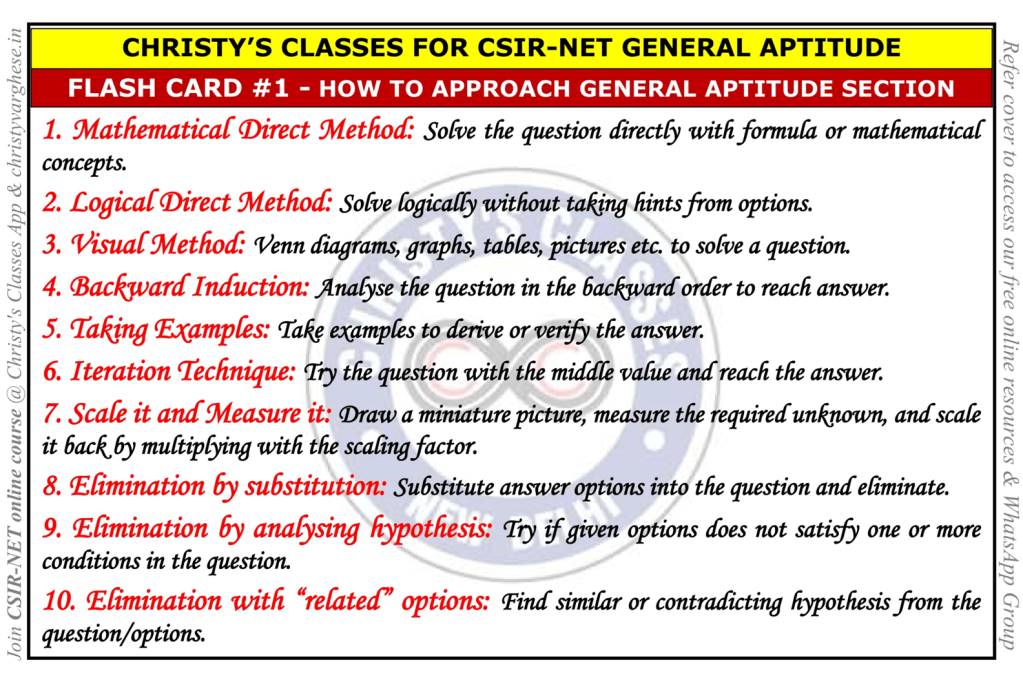
Practice makes it perfect! Train yourself to choose the right method to solve the question in the shortest time. Read Session 2 Notes or Buy the Book for more details.
A and B complete a work in 30 days. B and C complete the same work in 24 days whereas C and A complete the same work in 28 days. Based on these statements which of the following conclusions is correct? (CSIR-NET NOV 2020)
C is the most efficient and B is the least efficient.
Try again!
B is the most efficient but the least efficient one cannot be determined.
Try again!
C is the most efficient but, the least efficient one cannot be determined.
Try again!
C is the most efficient and A is the least efficient.
Time taken by C to complete the work = 45.4 days
Time taken by A to complete the work = 73 days
Time taken by B to complete the work = 50.9 days
Tip 4: Choose the Right Question
Approximate Question Distribution
Easy questions: 7 to 8
Medium level questions: 5 to 6
Difficult questions: 7 to 8
Train yourself to identify the difficulty of the question in the shortest time!
There are three fathers and six sons in a room. If every father’s son(s) and every son’s father are present, then the minimum number of individuals in the room are (CSIR-NET FEB 2022)
5
Try again!
7
That’s right! A is the grandfather of four children of B and C, who is are the children of A.
8
Try again!
9
Try again! This might be the natural option, but the question is bound to be tricky!
Tip 5: Finding the Catch in the Question
Find the Word or Phrase which gives you the solution at the earliest!
What is the volume of soil in an open pit of size 2 m × 2 m × 10 cm? (CSIR-NET FEB 2022, DEC 2017)
4 metre cube
Try again!
0.4 metre cube
Try again!
0 metre cube
Whatever be the size, this pit contains nothing.
40 metre cube
Try again!
Tip 6: Ignore Irrelevant Data
In a population of 900, the number of married couples is as much as the number of singles. There are 100 twins of which 50 twins are singles. The population has 400 females in all. What is the number of married persons? (CSIR-NET DEC 2019)
325
Try again!
600
That’s right
250
Try again!
300
Try again!
Tip 7: Choose the Right Starting Point
Seven persons A, B, C, D, E, F, and G are sitting in a row. E and B are sitting adjacent to each other. F is sitting between D and G. If C is sitting four places left of F, who among the following cannot be sitting at the centre? (CSIR-NET NOV 2020)
G
Try again!
B
Try again!
D
Try again!
F
That’s right
Other Tips
8. Be Fast in Arithmetic
9. Learn Basic Formula
10. Double check the keywords in the question
11. Find the Easy “Common Sense” Questions
12. Beware of very simple answers
13. Consider all the cases of the question
14. The power of Negative Thinking!!! Don’t give in to it!
Watch the video for more details!
More Materials
Follow us on one of these modes for more quizzes and updates. Feel free to ask your doubts in the comments below or in the video comments!
Note to blog subscribers: Click on the Heading to view post on the website with interactive course content, quizzes and updated materials.
Live Class
Tricks Discussed and More
You can learn more of such tricks with examples and practice questions from our book!
Questions
Ajay, Bunty, Chinu and Deb were agent, baker, compounder and designer, but not necessarily in that order. Deb told baker that Chinu is on his way. Ajay is sitting across the designer and next to the compounder. The designer didn’t say anything. What is each person’s occupation? (CSIR-NET DEC 2014)
A merchant buys equal numbers of shirts and trousers and pays Rs.38000. If the cost of 3 shirts is Rs.800 and that of a trouser is Rs.1000, then how many shirts were bought? (CSIR NET DEC 2014 )
60
You made some mistake! Try again!
30
That’s right!
15
You made some mistake! Try again!
10
You made some mistake! Try again!
Three friends R,S and T shared toffee from a bowl. R took 1/3rd of the toffees, but returned four to the bowl. S took 1/4th of what was left and returned 3 toffees to the bowl. T took half of the reminder but returned two back into the bowl. If the bowl had 17 toffees left, how many toffees were originally there in the bowl? (GATE 2011)
38
You made some mistake! Try again!
31
You made some mistake! Try again!
48
That’s right!
41
You made some mistake! Try again!
I bought a shirt at 10% discount and sold it to a friend at a loss of 10%. If the friend paid me Rs. 729.00 for the shirt, what was the undiscounted price of the shirt? (CSIR-NET June 2015)
Rs 1000
You made some mistake! Try again!
Rs 800
You made some mistake! Try again!
Rs 900
That’s right!
Rs 311.25
You made some mistake! Try again!
Similar Question for Practice
Among A, B, C and D, there is a lawyer, a doctor, a teacher and a journalist. They drink exactly one each of tea, coffee, lemonade and milk. If neither the lawyer nor the teacher drinks milk, B drinks coffee, A is the teacher and C is the doctor and drinks tea, then which of the following is FALSE? (CSIR-NET SEPT 2022 – LS)
A drinks lemonade
You made some mistake! Try again!
B is the journalist
That’s right!
The lawyer drinks coffee
You made some mistake! Try again!
D drinks milk.
You made some mistake! Try again!
In a class, there is one pencil for every two students, one eraser for every three students, and one ruler for every four students. If the total number of these stationery items required is 65, how many students are present in the class? (CSIR-NET November 2020)
55
You made some mistake! Try again!
60
That’s right!
65
You made some mistake! Try again!
70
You made some mistake! Try again!
One of the four – A, B, C and D – committed a crime. A said “I did it.”, B said, “I didn’t.” C said, “B did it.” D said, “A did it.”. Who is lying? (CSIR-NET DEC 2013)
A
You made some mistake! Try again!
B
You made some mistake! Try again!
C
That’s right!
D
You made some mistake! Try again!
Old Resources from the Channel
Following sessions discuss the above topics in detail. Watch-Like-Share!
More Materials
Follow us on one of these modes for more quizzes and updates. Feel free to ask your doubts in the comments below or in the video comments!
The candidates shall be required to answer any 15 questions. Each question shall be of two marks. The total marks allocated to this section shall be 30 out of 200.
Who will Benefit
This course will be beneficial for all CSIR-NET Subjects:
Life Sciences
Mathematical Sciences
Physical Sciences
Chemical Sciences
Earth Sciences
Those who are preparing for GATE-General Aptitude may benefit from this course as well. But you can refer to GATE Full course in the channel for more specific content.
More Materials
More materials and video descriptions will be given in this blog. Please don’t forget to follow this blog!
Sample Quiz
We will be posting sample quizzes like this in future materials posted here. Here’s one to familiarise yourself with it!
This is a sample quiz
This familiarises quizzes in the blog.
We will be posting quizzes like this in the blog!
This is the right answer.
Right answers come in green.
This is a wrong answer.
Wrong answer? Don’t worry! It’s a learning environment; try again!